
The Basics
Pickleball is an incredibly accessible sport that combines elements of tennis, badminton, and ping-pong. Played on a badminton-sized court with a modified tennis net, the game uses solid paddles and a plastic ball with holes (similar to a wiffle ball). It can be played as singles or doubles, though doubles is the most common format. The beauty of pickleball lies in its simplicity; beginners can learn the basics in minutes, yet the game offers depth and strategy.
Helpful Videos:
Playing a match:
- Determine Who Serves:
- Players usually flip a paddle to decide which team serves first and which side they start on.
- The score starts 0-0, (In doubles, the score is called as three numbers: Server Score – Receiver Score – Server Number(1 or 2). The starting team gets only one server turn, meaning double’s matches start at 0-0-2.)
- The First Serve:
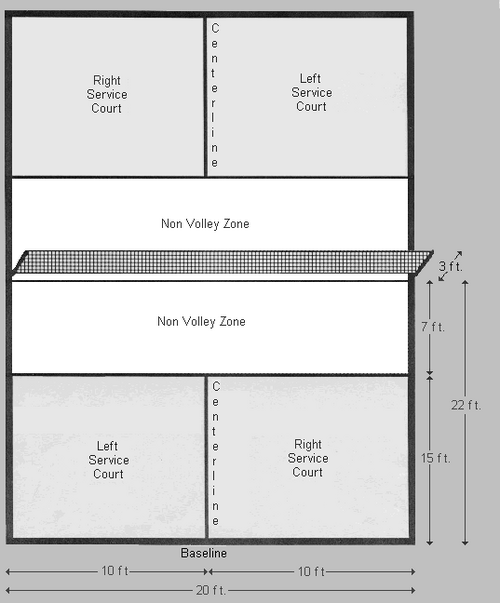
- The starting server stands in the right-hand service box. They hit the ball underhand diagonally into the opponent’s right-hand service box.
- The Double Bounce Rule: The receiving team must let the ball bounce once before returning it. The serving team must then let that return bounce once before hitting it.
- General Play:
- After the first two bounces (one on each side), players may volley the ball (hit it in the air) or let it bounce.
- The Kitchen Rule: Players cannot volley the ball while standing inside the Non-Volley Zone (the Kitchen). They can enter the kitchen to hit a ball that has bounced, but they must re-establish their feet outside the kitchen before volleying again.
- Winning the Point: If the receiving team commits a fault (hits it out, into the net, or violates a kitchen rule), the serving team scores a point.
- Side Out (Loss of Serve):
- If the serving team commits a fault, the ball passes to their partner (if playing doubles and they haven’t served yet), otherwise a ‘side out’ occurs, meaning the ball goes to the opponent who now has a chance to serve.
- Server Rotation:
- When the serving team scores a point, the server switches sides (moves from Right to Left box, or Left to Right) and serves again.
- The receiving team does not switch sides when points are scored; they only switch when they become the serving team.
- End of the Game:
- Reaching 11: Play continues with rallies, side-outs, and scoring until one team reaches 11 points.
- The “Win by 2” Rule: If the score becomes 10-10, the game goes into “overtime.” The game continues until one team leads by 2 points (e.g., 12-10, 13-11).
- Game Conclusion: The match ends when a team has at least 11 points and a 2-point lead.